


 |
Start of Tutorial > Start of Trail | Lesson Contents |

|
Trail: Collections |
|
Help
on searching
Search technology |
Interfaces
The core collection interfaces are the interfaces used to manipulate collections, and to pass them from one method to another. The basic purpose of these interfaces is to allow collections to be manipulated independently of the details of their representation. The core collection interfaces are the heart and soul of the collections framework. When you understand how to use these interfaces, you know most of what there is to know about the framework. The core collections interfaces are shown below: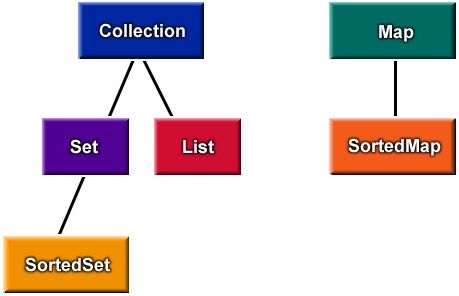
Set is a special kind of Collection, and a
SortedSet is a special kind of Set, and so forth.
Note also that the hierarchy consists of two distinct trees: a
Map is not a true Collection.
To keep the number of core collection interfaces managable, the the JDK
doesn't provide separate interfaces for each variant of each collection type.
(Among the possible variants are immutable, fixed-size, and append-only.)
Instead, the modification operations in each interface are designated
optional: a given implementation may not support some of these
operations. If an unsupported operation is invoked, a collection throws an
UnsupportedOperationException
. Implementations are responsible for documenting which of the optional
operations they support. All of the JDK's general purpose implementations
support all of the optional operations.

The four sections that follow teach you how to use each of the four basic core collection interfaces. In particular, they describe the idioms that allow you to use these interfaces effectively.
Collection
The CollectionCollectionrepresents a group of objects, known as its elements. SomeCollectionimplementations allow duplicate elements and others do not. Some are ordered and others unordered. The JDK doesn't provide any direct implementations of this interface: It provides implementations of more specific subinterfaces likeSetandList. This interface is the least common denominator that all collections implement. Collection is used to pass collections around and manipulate them when maximum generality is desired.
Set
A Set
List
A ListListgenerally has precise control over where in theListeach element is inserted. The user can access elements by their integer index (position). If you've used VectorList.
Map
A MapMap.
The last two core collection interfaces (SortedSet and
SortedMap) are merely sorted versions of Set and
Map. In order to understand these interfaces, you have to know
how order is maintained among objects. Even if you don't plan to use
SortedSet or SortedMap, read the
following section if you plan to sort Lists.
Object Ordering
There are two ways to order objects: The Comparable
Now that you know all about object ordering, here are the last two core collection interfaces:
SortedSet
ASortedSetis aSetthat maintains its elements in ascending order. Several additional operations are provided to take advantage of the ordering. TheSortedSetinterface is used for things like word lists and membership rolls.
SortedMap
A SortedMapMapthat maintains its mappings in ascending key order. It is theMapanalogue ofSortedSet. TheSortedMapinterface is used for apps like dictionaries and telephone directories.
|
|
Start of Tutorial > Start of Trail | Lesson Contents |