


 |
Start of Tutorial |
Trail Contents
|

|
Help
on searching
Search technology |
The Extension Mechanism
by Alan Sommerer
The extension mechanism is a new feature in the JavaTM 1.2 platform. The extension mechanism provides a standard, scalable way to make custom APIs available to all applications running on the Java platform.
Your feedback is important to us! If you have comments about this trail, send them to: tutorial@java.sun.com. In your message, put extensions in the subject header.
Extensions are groups of packages and classes that augment the Java platform through the extension mechanism. The extension mechanism enables the runtime environment to find and load extension classes without the extension classes having to be named on the class path. In that respect, extension classes are similar to the Java platform's core classes. That's also where extensions get their name -- they, in effect, extend the platform's core API.
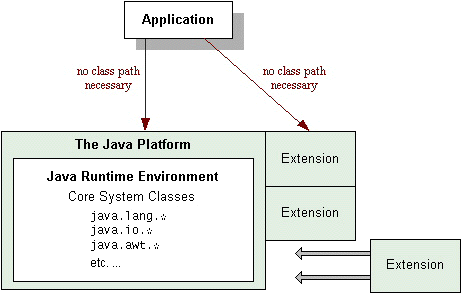
This figure has been reduced to fit on the page.
Click the image to view it at its natural size.
As the diagram indicates, extensions act as "add-on" modules to the Java platform. Their classes and public APIs are automatically available to any applications running on the platform.
The extension mechanism also provides a means for extension classes to be downloaded from remote locations for use by applets.
Extensions are bundled as Java Archive (JAR) files, and this trail assumes that you are familiar with the JAR file format. If you're not up to speed on JAR files, you might want to review some JAR-file documentation before proceeding with the lessons in this trail:
- The JAR File Format trail in this tutorial.
- The JAR Guide in the JDKTM documentation.
This trail has two lessons:
Creating and Using Extensions
shows you what you need to do to add an extension to your Java platform
and how applets can benefit from the extension mechanism by
downloading remote extension classes.
Making Extensions Secure shows you how to control the
security privileges and
permissions that are granted to extensions on your platform. You'll
see how to use the Java platform's security architecture if you're writing
extensions classes of your own.
Additional Documentation
You can find further information about extensions in the The Java Extensions Mechanism section of the JDK 1.2 documentation.|
|
Start of Tutorial |
Trail Contents
|