


 |
Start of Tutorial > Start of Trail > Start of Lesson | Lesson Contents |

|
Trail: Learning the Java Language |
|
Lesson: Objects and Classes in Java |
|
Help
on searching
Search technology |
Understanding Instance and Class Members
When you declare a member variable such asaFloat in MyClass:
class MyClass {
    float aFloat;
}
you declare an instance variable. Every time you create an instance of a class, the runtime system creates one copy of each the class's instance variables for the instance. You can access an object's instance variables from an object as described in Using Objects.
Instance variables are in constrast to class variables (which
you declare using the static modifier). The runtime system allocates
class variables once per class regardless of the number of instances created
of that class. The system allocates memory for class variables the first
time it encounters the class. All instances share the same copy of the
class's class variables. You can access class variables through an instance
or through the class itself.
Methods are similar: Your classes can have instance methods and class methods. Instance methods operate on the current object's instance variables but also have access to the class variables. Class methods, on the other hand, cannot access the instance variables declared within the class (unless they create a new object and access them through the object). Also, class methods can be invoked on the class, you don't need an instance to call a class method.
By default, unless otherwise specified, a member declared within a class
is an instance member. The class defined below has one instance variable--an
integer named x--and two instance methods--x and setX--that let
other objects set and query the value of x:
class AnIntegerNamedX {
    int x;
    public int x() {
        return x;
    }
    public void setX(int newX) {
        x = newX;
    }
}
Every time you instantiate a new object from a class, you get a new
copy of each of the class's instance variables. These copies are associated
with the new object. So, every time you instantiate a new AnIntegerNamedX
object from the class, you get a new copy of x that is associated with
the new AnIntegerNamedX object.
All instances of a class share the same implementation of an instance
method; all instances of AnIntegerNamedX share the same implementation
of x and setX. Note that both methods, x and setX,
refer to the object's instance variable x by name. "But",
you ask, "if all instances of AnIntegerNamedX share the same implementation
of x and setX isn't this ambiguous?" The answer
is "no." Within an instance method, the name of an instance variable
refers to the current object's instance variable, assuming that the instance
variable isn't hidden by a method parameter. So, within x and
setX, x is equivalent to this.x.
Objects outside of AnIntegerNamedX that wish to access x
must do so through a particular instance of AnIntegerNamedX. Suppose
that this code snippet was in another object's method. It creates two different
objects of type AnIntegerNamedX, sets their x values
to different values, then displays them:
. . .
AnIntegerNamedX myX = new AnIntegerNamedX();
AnIntegerNamedX anotherX = new AnIntegerNamedX();
myX.setX(1);
anotherX.x = 2;
System.out.println("myX.x = " + myX.x());
System.out.println("anotherX.x = " + anotherX.x());
. . .
Notice that the code used setX to set the x value
for myX but just assigned a value to anotherX.x directly.
Either way, the code is manipulating two different copies of x:
the one contained in the myX object and the one contained in the
anotherX object. The output produced by this code snippet is:
myX.x = 1
anotherX.x = 2
showing that each instance of the class AnIntegerNamedX has
its own copy of the instance variable x and each x has
a different value.
You can, when declaring a member variable, specify that the variable is a class rather than an instance variable. Similarly, you can specify that a method is a class method rather than an instance method. The system creates a single copy of a class variable the first time it encounters the class in which the variable is defined. All instances of that class share the same copy of the class variable. Class methods can only operate on class variables--they cannot access the instance variables defined in the class.
To specify that a member variable is a class variable, use the static
keyword. For example, let's change the AnIntegerNamedX class such
that its x variable is now a class variable:
class AnIntegerNamedX {
    static int x;
    public int x() {
        return x;
    }
    public void setX(int newX) {
        x = newX;
    }
}
Now the exact same code snippet from before that
creates two instances of AnIntegerNamedX, sets their x values,
and then displays them produces this, different, output.
myX.x = 2
anotherX.x = 2
The output is different because x is now a class variable so
there is only one copy of the variable and it is shared by all instances
of AnIntegerNamedX, including myX and anotherX.
When you invoke setX on either instance, you change the value
of x for all instances of AnIntegerNamedX.
You use class variables for items that you need only one copy of and
which must be accessible by all objects inheriting from the class in which
the variable is declared. For example, class variables are often used with
final to define constants; this is more memory efficient than
final instance variables because constants can't change, so you really
only need one copy).
Similarly, when declaring a method, you can specify that method to be a class method rather than an instance method. Class methods can only operate on class variables and cannot access the instance variables defined in the class.
To specify that a method is a class method, use the static
keyword in the method declaration. Let's change the AnIntegerNamedX
class such that its member variable x is once again an instance
variable, and its two methods are now class methods:
class AnIntegerNamedX {
    private int x;
    static public int x() {
        return x;
    }
    static public void setX(int newX) {
        x = newX;
    }
}
When you try to compile this version of AnIntegerNamedX, you will get compiler errors:
AnIntegerNamedX.java:4: Can't make a static reference to nonstatic variable x in class AnIntegerNamedX.
        return x;
               ^
AnIntegerNamedX.java:7: Can't make a static reference to nonstatic variable x in class AnIntegerNamedX.
        x = newX;
        ^
2 errors
This is because class methods cannot access instance variables unless
the method created an instance of AnIntegerNamedX first and accessed
the variable through it.
Let's fix AnIntegerNamedX by making its x variable
a class variable:
class AnIntegerNamedX {
    static private int x;
    static public int x() {
        return x;
    }
    static public void setX(int newX) {
        x = newX;
    }
}
Now the class will compile and the same code snippet from
before that creates two instances of AnIntegerNamedX, sets
their x values, and then prints the x values produces
this output:
myX.x = 2
anotherX.x = 2
Again, changing x through myX also changes it for
other instances of AnIntegerNamedX.
Another difference between instance members and class members is that
class members are accessible from the class itself. You don't need to instantiate
a class to access its class members. Let's rewrite the code snippet from
before to access x and setX directly from the AnIntegerNamedX
class:
. . .
AnIntegerNamedX.setX(1);
System.out.println("AnIntegerNamedX.x = " + AnIntegerNamedX.x());
. . .
Notice that you no longer have to create myX and anotherX.
You can set x and retrieve x directly from the AnIntegerNamedX
class. You cannot do this with instance members, you can only invoke instance
methods from an object and can only access instance variables from an object.
You can access class variables and methods either from an instance of the
class or from the class itself.
Initializing Instance and Class Members
You can use static initializers and instance initializers to provide initial values for class and instance members when you declare them in a class:This works well for members of primitive data type. Sometimes, it even works when creating arrays and objects. But this form of initialization has limitations, as follows:class BedAndBreakfast { static final int MAX_CAPACITY = 10; boolean full = false; }If you have some initialization to perform that cannot be done in an initializer because of one of these limitations, you have to put the initialization code elsewhere. To initialize class members, put the initialization code in a static initialization block. To initialize instance members, put the initialization code in a constructor.
- Initializers can perform only initializations that can be expressed in an assignment statement.
- Initializers cannot call any method that can throw a checked exception.
- If the initializer calls a method that throws a runtime exception, then it cannot do error recovery.
Using Static Initialization Blocks
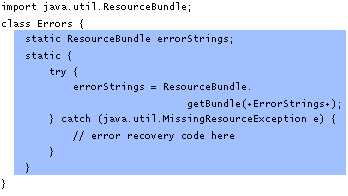
Here's an example of a static initialization block:The errorStringsresource bundle must be initialized in a static initialization block. This is because error recovery must be performed if the bundle cannot be found. Also,errorStringsis a class member and it doesn't make sense for it to be initialized in a constructor. As the previous example shows, a static initialization block begins with thestatickeyword and is a normal block of Java code enclosed in curly braces {}.A class can have any number of static initialization blocks that appear anywhere in the class body. The runtime system guarantees that static initialization blocks and static initializers are called in the order (left-to-right, top-to-bottom) that they appear in the source code.
Initializing Instance Members
If you want to initialize an instance variable and cannot do it in the variable declaration for the reasons cited previously, then put the initialization in the constructor(s) for the class. Suppose theerrorStringsbundle in the previous example is an instance variable rather than a class variable. Then you'd use the following code to initialize it:The code that initializesimport java.util.ResourceBundle; class Errors { ResourceBundle errorStrings; Errors() { try { errorStrings = ResourceBundle. getBundle("ErrorStrings"); } catch (java.util.MissingResourceException e) { // error recovery code here } } }errorStringsis now in a constructor for the class.Sometimes a class contains many constructors and each constructor allows the caller to provide initial values for different instance variables of the new object. For example,
java.awt.Rectanglehas these three constructors:The default constructor doesn't let the caller provide initial values for anything, and the other two constructors let the caller set initial values either for the origin or for the origin and size. Yet, all of the instance variables, the origin and the size, forRectangle(); Rectangle(int width, int height); Rectangle(int x, int y, int width, int height);Rectanglemust be initialized. In this case, classes often have one constructor that does all of the work. The other constructors call this constructor and provide it either with the values from its parameters or with default values. For example, here are the possible implementations of the threeRectangleconstructors shown previously (assumex,y,width, andheightare the names of the instance variables to be initialized):The Java language supports instance initialization blocks, which you could use instead. However, these are intended to be used with anonymous classes, which cannot declare constructors.Rectangle() { this(0,0,0,0); } Rectangle(int width, int height) { this(0,0,width,height); } Rectangle(int x, int y, int width, int height) { this.x = x; this.y = y; this.width = width; this.height = height; }The approach described here that uses constructors is better for these reasons:
- All of the initialization code is in one place, thus making the code easier to maintain and read.
- Defaults are handled explicitly.
- Constructors are widely understood by the Java community, including relatively new Java programmers, while instance initializers are not and may cause confusion to others reading your code.
|
|
Start of Tutorial > Start of Trail > Start of Lesson | Lesson Contents |