


 |
Start of Tutorial > Start of Trail > Start of Lesson | Lesson Contents |

|
Trail: Learning the Java Language |
|
Lesson: More Features of the Java Language |
|
Help
on searching
Search technology |
Defining an Interface
The following figure shows that an interface definition has two components: the interface declaration and the interface body. The interface declaration declares various attributes about the interface such as its name and whether it extends another interface. The interface body contains the constant and method declarations within that interface.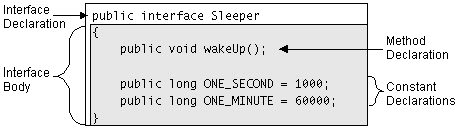
The Interface Declaration
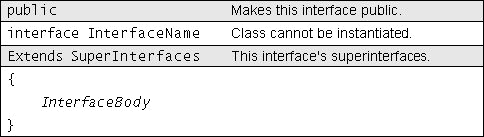
The declaration for theSleeperinterface uses the two required elements of an interface declaration--theinterfacekeyword and the name of the interface--plus thepublicaccess modifier :An interface declaration can have one other component: thepublic interface Sleeper { . . . }publicaccess specifier and a list of superinterfaces. The full interface declaration looks like this figure:The
This figure has been reduced to fit on the page.
Click the image to view it at its natural size.publicaccess specifier indicates that the interface can be used by any class in any package. If you do not specify that your interface is public, then your interface will be accessible only to classes that are defined in the same package as the interface.An interface can extend other interfaces just as a class can extend or subclass another class. However, while a class can extend only one other class, an interface can extend any number of interfaces. The list of superinterfaces is a comma-delimited list of all of the interfaces extended by the new interface. An interface inherits all constants and methods from its superinterfaces, unless the interface hides a constant with another of the same name or redeclares a method with a new method declaration.
The Interface Body
The interface body contains method declarations for all of the methods included in the interface. Here's the body of theSleeperinterface:The method declaration forpublic interface Sleeper { public void wakeUp(); public long ONE_SECOND = 1000; public long ONE_MINUTE = 60000; }wakeUpis followed by a semicolon (;) because an interface does not provide implementations for the methods declared within it. All methods declared in an interface are implicitlypublicandabstract. The use of these modifiers on a method declaration in an interface is discouraged as a matter of style.An interface can contain constant declarations in addition to method declarations. The
Sleeperinterface declares two constants that are useful arguments toletMeSleepFor. All constant values defined in an interface are implicitlypublic,static, andfinal. The use of these modifiers on a constant declaration in an interface is discouraged as a matter of style.Any class can use an interface's constants from the name of the interface, like this:
Classes that implement an interface can treat the constants as though they were inherited. This is whySleeper.ONE_SECONDGUIClockcan useONE_MINUTEdirectly when callingletMeSleepFor:Member declarations in an interface disallow the use of some declaration modifiers; you may not usepublic class GUIClock extends Applet implements Sleeper { . . . public void wakeUp() { repaint(); clock.letMeSleepFor(this, ONE_MINUTE); } }transient,volatile, orsynchronizedin a member declaration in an interface. Also, you may not use theprivateandprotectedspecifiers when declaring members of an interface.
Note: Previous releases of the Java platform allowed you to use theabstractmodifier on interface declarations and on method declarations within interfaces. However this is unnecessary, since interfaces and their methods are implicitly abstract. You should no longer be usingabstractin your interface declarations or in your method declarations within interfaces.
|
|
Start of Tutorial > Start of Trail > Start of Lesson | Lesson Contents |