


 |
Start of Tutorial > Start of Trail > Start of Lesson | Lesson Contents |

|
Trail: Learning the Java Language |
|
Lesson: More Features of the Java Language |
|
Help
on searching
Search technology |
Implementing Nested Classes
As you learned in Using an Inner Class to Implement an Adapter Java lets you define a class as a member of another class. Such a class is called a nested class and is illustrated here:
class EnclosingClass{
    . . .
    class ANestedClass {
        . . .
    }
}
Definition: A nested class is a class that is a member of another class.
You use nested classes to reflect and enforce the relationship between two classes. You should define a class within another class when the nested class makes sense only in the context of its enclosing class or when it relies on the enclosing class for its function. For example, a text cursor makes sense only in the context of a particular text component.
As a member of its enclosing class, a nested class has a special privilege: It has unlimited access to its enclosing class's members, even if they are declared private. However, this special privilege isn't really special at all. It is fully consistent with the meaning of private and the other access specifiers. The access specifiers restrict access to members for classes outside of the enclosing class. The nested class is inside of its enclosing class so that it has access to its enclosing class's members.
Like other members, a nested class can be declared static (or not). A static nested class is called just that: a static nested class. A nonstatic nested class is called an inner class. These are illustrated in the following code:
class EnclosingClass{
    . . .
    static class AStaticNestedClass {
        . . .
    }
    class InnerClass {
        . . .
    }
}
As with instance methods and variables, an inner class is associated with an instance of its enclosing class and has direct access to that object's instance variables and methods. Also, because an inner class is associated with an instance, it cannot define any static members itself.
To help differentiate the terms nested class and inner class further, we suggest you think about them in the following way. The term "nested class" reflects the syntactic relationship between two classes; that is, syntactically, the code for one class appears within the code of another. In contrast, the term "inner class" reflects the relationship between instances of the two classes. Consider the following classes:
class EnclosingClass {
    . . .
    class InnerClass {
        . . .
    }
}
InnerClass is syntactically defined within
EnclosingClass.
Rather, it's that an instance of InnerClass can exist
only within an instance of EnclosingClass
and that it has direct access
to instance variables and methods of its enclosing instance.
The following diagram illustrates this idea.
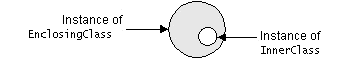
Definition: An inner class is a nested class whose instance exists within an instance of its enclosing class and has direct access to the instance members of its enclosing instance.
Other Facts about Nested Classes
Like other classes, nested classes can be declaredabstractorfinal. The meaning of these two modifiers for nested classes is the same as for other classes. Also, the access specifiers--private,public,protected, and package--- may be used to restrict access to nested classes just as they do to other class members.Any nested class, not just anonymous ones, can be declared in any block of code. A nested class declared within a method or other smaller block of code has access to any final, local variables in scope.
|
|
Start of Tutorial > Start of Trail > Start of Lesson | Lesson Contents |