


 |
Start of Tutorial > Start of Trail > Start of Lesson | Lesson Contents |

|
Trail: RMI |
|
Lesson: Using Java RMI |
|
Help
on searching
Search technology |
Creating A Client Program
The compute engine is a pretty simple program: it runs tasks that are handed to it. The clients for the compute engine are more complex. A client needs to call the compute engine, but it also has to define the task to be performed by the compute engine.
Two separate classes make up the client in our example. The first
class, ComputePi, looks up and calls a
Compute object. The second class, Pi,
implements the Task interface and defines the work to be
done by the compute engine. The job of the Pi class is to
compute the value of
 to some number of decimal places.
As you recall, the nonremote
Task
interface is defined as follows:
package compute;

public interface Task extends java.io.Serializable {
    Object execute();
}
The Task interface extends
java.io.Serializable so that an object that implements the
interface can be serialized by the RMI runtime and sent to a remote
virtual machine as part of a remote method invocation. We could have
chosen to have our implementation classes implement both the Task
interface and the Serializable interface and gotten the
same effect. However, the whole purpose of the Task
interface is to allow implementations of that interface to be passed to
a Compute object, so having a class that implements the
Task interface that does not also implement the
Serializable interface doesn't make sense. Therefore we
associate the two interfaces explicitly in the type system, ensuring
that all Task objects are serializable.
The code that calls a Compute object's methods must obtain
a reference to that object, create a Task object, and then
request that the task be executed. The definition of the task
Pi is shown later. A Pi object is constructed
with a single argument, the desired precision of the result. The result
of the task execution is a java.math.BigDecimal
representing
calculated to the specified precision.
The client class
client.ComputePi
is as follows.
package client;

import java.rmi.*;
import java.math.*;
import compute.*;

public class ComputePi {
    public static void main(String args[]) {
        if (System.getSecurityManager() == null) {
            System.setSecurityManager(new RMISecurityManager());
        }
        try {
            String name = "//" + args[0] + "/Compute";
            Compute comp = (Compute) Naming.lookup(name);
            Pi task = new Pi(Integer.parseInt(args[1]));
            BigDecimal pi = (BigDecimal) (comp.executeTask(task));
            System.out.println(pi);
        } catch (Exception e) {
            System.err.println("ComputePi exception: " +
                               e.getMessage());
            e.printStackTrace();
        }
    }
}
Like the ComputeEngine server, the client begins by
installing a security manager. This is necessary because RMI could be
downloading code to the client. In this example the
ComputeEngine's stub is downloaded to the client. Any time
code is downloaded by RMI, a security manager must be present. As with
the server, the client uses the security manager provided by the RMI
system for this purpose.
After installing a security manager, the client constructs a name used
to look up a Compute remote object. The value of the first
command line argument, args[0], is the name of the remote
host on which the Compute object runs. The client uses the
Naming.lookup method to look up the remote object by name
in the remote host's registry. When doing the name lookup, the code
creates a URL that specifies the host where the compute server is
running. The name passed in the Naming.lookup call has the
same URL syntax as the name passed in the Naming.rebind
call, which was discussed earlier.
Next, the client creates a new Pi object, passing to the
Pi constructor the second command line argument,
args[1], which indicates the number of decimal places to
use in the calculation. Finally, the client invokes the
executeTask method of the Compute remote
object. The object passed into the executeTask call
returns an object of type java.math.BigDecimal, so the
program casts the result to that type and stores the return value in
the variable result. Then, the program prints out the
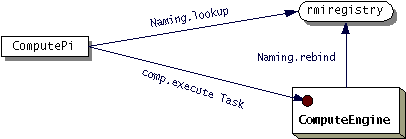
result. The following figure depicts the flow of messages among the
ComputePi client, the rmiregistry, and the
ComputeEngine.
Finally, let's look at the reason for all of this in the first place:
the Pi class. This class implements the Task
interface and computes the value of
 to a specified number of decimal places. For this example the actual
algorithm is unimportant except, of course, for the accuracy of the
computation. All that is important is that the computation is
numerically rather expensive and thus the sort of thing that you would
want to have occur on a more capable server.
Here is the code for the class client.Pi, which implements
Task.
package client;

import compute.*;
import java.math.*;

public class Pi implements Task {

    /** constants used in pi computation */
    private static final BigDecimal ZERO =
        BigDecimal.valueOf(0);
    private static final BigDecimal  ONE =
        BigDecimal.valueOf(1);
    private static final BigDecimal FOUR =
        BigDecimal.valueOf(4);

    /** rounding mode to use during pi computation */
    private static final int roundingMode =
        BigDecimal.ROUND_HALF_EVEN;

    /** digits of precision after the decimal point */
    private int digits;

    /**
     * Construct a task to calculate pi to the specified
     * precision.
     */
    public Pi(int digits) {
        this.digits = digits;
    }

    /**
     * Calculate pi.
     */
    public Object execute() {
        return computePi(digits);
    }

    /**
     * Compute the value of pi to the specified number of
     * digits after the decimal point.  The value is
     * computed using Machin's formula:
     *
     *          pi/4 = 4*arctan(1/5) - arctan(1/239)
     *
     * and a power series expansion of arctan(x) to
     * sufficient precision.
     */
    public static BigDecimal computePi(int digits) {
        int scale = digits + 5;
        BigDecimal arctan1_5 = arctan(5, scale);
        BigDecimal arctan1_239 = arctan(239, scale);
        BigDecimal pi = arctan1_5.multiply(FOUR).subtract(
                                  arctan1_239).multiply(FOUR);
        return pi.setScale(digits,
                           BigDecimal.ROUND_HALF_UP);
    }
    /**
     * Compute the value, in radians, of the arctangent of
     * the inverse of the supplied integer to the speficied
     * number of digits after the decimal point.  The value
     * is computed using the power series expansion for the
     * arc tangent:
     *
     * arctan(x) = x - (x^3)/3 + (x^5)/5 - (x^7)/7 +
     *     (x^9)/9 ...
     */
    public static BigDecimal arctan(int inverseX,
                                  int scale)
    {
        BigDecimal result, numer, term;
        BigDecimal invX = BigDecimal.valueOf(inverseX);
        BigDecimal invX2 =
            BigDecimal.valueOf(inverseX * inverseX);

        numer = ONE.divide(invX, scale, roundingMode);

        result = numer;
        int i = 1;
        do {
            numer =
                numer.divide(invX2, scale, roundingMode);
            int denom = 2 * i + 1;
            term =
                numer.divide(BigDecimal.valueOf(denom),
                             scale, roundingMode);
            if ((i % 2) != 0) {
                result = result.subtract(term);
            } else {
                result = result.add(term);
            }
            i++;
        } while (term.compareTo(ZERO) != 0);
        return result;
    }
}
The most interesting feature of this example is that the
Compute object never needs Pi's class
definition until a Pi object is passed in as an argument
to the executeTask method. At that point the code for the
class is loaded by RMI into the Compute object's virtual
machine, the execute method is called, and the task's code
is executed. The resulting Object, which in the case of
the Pi task is a java.math.BigDecimal object,
is handed back to the calling client, where it is used to print out the
result of the calculation.
The fact that the supplied Task object computes the value
of Pi is irrelevant to the ComputeEngine
object. You could also implement a task that, for example, generated a
random prime number by using a probabilistic algorithm. That would also
be numerically intensive and therefore a candidate for being shipped
over to the ComputeEngine, but it would involve very
different code. This code could also be downloaded when the
Task object was passed to a Compute object.
In just the way that the algorithm for computing Pi is
brought in when needed, the code that generates the random prime would
be brought in when needed. The Compute object knows only
that each object it receives implements the execute
method; it does not know, and does not need to know, what the implementation does.
|
|
Start of Tutorial > Start of Trail > Start of Lesson | Lesson Contents |