


 |
Start of Tutorial > Start of Trail > Start of Lesson | Lesson Contents |

|
Trail: RMI |
|
Lesson: Using Java RMI |
|
Help
on searching
Search technology |
Designing a Remote Interface
At the heart of the compute engine is a protocol that allows jobs to be submitted to the compute engine, the compute engine to run those jobs, and the results of the job to be returned to the client. This protocol is expressed in interfaces supported by the compute engine and by the objects that are submitted to the compute engine, as shown in the following figure.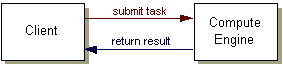
Each of the interfaces contains a single method. The compute engine's
interface, Compute, allows jobs to be submitted to the
engine; the client interface, Task, defines how the
compute engine executes a submitted task.
The
compute.Compute
interface defines the remotely
accessible part--the compute engine itself.
Here is the remote interface with its single method:
package compute;

import java.rmi.Remote;
import java.rmi.RemoteException;

public interface Compute extends Remote {
    Object executeTask(Task t) throws RemoteException;
}
By extending the interface java.rmi.Remote,
this interface marks itself as one whose methods can be called from any
virtual machine. Any object that implements this interface becomes a
remote object.
As a member of a remote interface, the executeTask method
is a remote method. Therefore the method must be defined as being
capable of throwing a java.rmi.RemoteException. This
exception is thrown by the RMI system during a remote method call to
indicate that either a communication failure or a protocol error has
occurred. A RemoteException is a checked exception, so any
code making a call to a remote method needs to handle this exception by
either catching it or declaring it in its throws clause.
The second interface needed for the compute engine defines the type
Task. This type is used as the argument to the
executeTask method in the Compute interface.
The
compute.Task
interface defines the interface between
the compute engine and the work that it needs to do, providing the way
to start the work.
package compute;

import java.io.Serializable;

public interface Task extends Serializable {
    Object execute();
}
The Task interface defines a single method,
execute, which returns an Object,
has no parameters, and throws no exceptions.
Since the interface does not extend Remote,
the method in this interface doesn't need to list
java.rmi.RemoteException in its throws
clause.
The return value for the Compute's executeTask
and Task's execute methods is declared to be of type
Object. This means that any task that wants to return a
value of one of the primitive types, such as an int or a
float, needs to create an instance of the equivalent
wrapper class for that type, such as an Integer or a
Float, and return that object instead.
Note that the Task interface extends the
java.io.Serializable interface. RMI uses the object
serialization mechanism to transport objects by value between Java
virtual machines. Implementing Serializable marks the
class as being capable of conversion into a self-describing byte stream
that can be used to reconstruct an exact copy of the serialized object
when the object is read back from the stream.
Different kinds of tasks can be run by a Compute
object as long as they are implementations of the Task
type. The classes that implement this interface can contain any data
needed for the computation of the task and any other methods needed for
the computation.
Here is how RMI makes this simple compute engine possible.
Since RMI can assume that the Task
objects are written in the Java programming language,
implementations of the Task
object that were previously unknown to the compute engine are
downloaded by RMI into the compute engine's virtual machine as needed.
This allows clients of the compute engine to define new kinds of tasks
to be run on the server machine without needing the code to be
explicitly installed on that machine. In addition, because the
executeTask method returns a java.lang.Object,
any type of object can be passed as a return value in the remote call.
The compute engine, implemented by the ComputeEngine
class, implements the Compute
interface, allowing different tasks to be submitted to it by calls to
its executeTask method. These tasks are run using the
task's implementation of the execute method. The compute
engine reports results to the caller through its return value: an
Object.
|
|
Start of Tutorial > Start of Trail > Start of Lesson | Lesson Contents |