


 |
Start of Tutorial > Start of Trail > Start of Lesson | Lesson Contents |

|
Trail: RMI |
|
Lesson: Using Java RMI |
|
Help
on searching
Search technology |
An Overview of RMI Applications
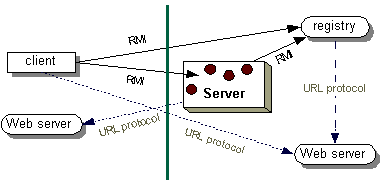
RMI applications are often comprised of two separate programs: a server and a client. A typical server application creates some remote objects, makes references to them accessible, and waits for clients to invoke methods on these remote objects. A typical client application gets a remote reference to one or more remote objects in the server and then invokes methods on them. RMI provides the mechanism by which the server and the client communicate and pass information back and forth. Such an application is sometimes referred to as a distributed object application.Distributed object applications need to
- Locate remote objects:
Applications can use one of two mechanisms to obtain references to
remote objects. An application can register its remote objects
with RMI's simple naming facility, the
rmiregistry, or the application can pass and return remote object references as part of its normal operation. - Communicate with remote objects: Details of communication between remote objects are handled by RMI; to the programmer, remote communication looks like a standard Java method invocation.
- Load class bytecodes for objects that are passed around: Because RMI allows a caller to pass objects to remote objects, RMI provides the necessary mechanisms for loading an object's code, as well as for transmitting its data.
- Advantages of Dynamic Code Loading
- Remote Interfaces, Objects, and Methods
- Creating Distributed Applications Using RMI
- Building a Generic Compute Engine
Advantages of Dynamic Code Loading
One of the central and unique features of RMI is its ability to download the bytecodes (or simply code) of an object's class if the class is not defined in the receiver's virtual machine. The types and the behavior of an object, previously available only in a single virtual machine, can be transmitted to another, possibly remote, virtual machine. RMI passes objects by their true type, so the behavior of those objects is not changed when they are sent to another virtual machine. This allows new types to be introduced into a remote virtual machine, thus extending the behavior of an application dynamically. The compute engine example in this chapter uses RMI's capability to introduce new behavior to a distributed program.
Remote Interfaces, Objects, and Methods
Like any other application, a distributed application built using Java RMI is made up of interfaces and classes. The interfaces define methods, and the classes implement the methods defined in the interfaces and, perhaps, define additional methods as well. In a distributed application some of the implementations are assumed to reside in different virtual machines. Objects that have methods that can be called across virtual machines are remote objects.An object becomes remote by implementing a remote interface, which has the following characteristics.
- A remote interface extends the interface
java.rmi.Remote.- Each method of the interface declares
java.rmi.RemoteExceptionin itsthrowsclause, in addition to any application-specific exceptions.RMI treats a remote object differently from a nonremote object when the object is passed from one virtual machine to another. Rather than making a copy of the implementation object in the receiving virtual machine, RMI passes a remote stub for a remote object. The stub acts as the local representative, or proxy, for the remote object and basically is, to the caller, the remote reference. The caller invokes a method on the local stub, which is responsible for carrying out the method call on the remote object.
A stub for a remote object implements the same set of remote interfaces that the remote object implements. This allows a stub to be cast to any of the interfaces that the remote object implements. However, this also means that only those methods defined in a remote interface are available to be called in the receiving virtual machine.
Creating Distributed Applications Using RMI
When you use RMI to develop a distributed application, you follow these general steps.
- Design and implement the components of your distributed application.
- Compile sources and generate stubs.
- Make classes network accessible.
- Start the application.
Design and Implement the Application Components
First, decide on your application architecture and determine which components are local objects and which ones should be remotely accessible. This step includes:
- Defining the remote interfaces: A remote interface specifies the methods that can be invoked remotely by a client. Clients program to remote interfaces, not to the implementation classes of those interfaces. Part of the design of such interfaces is the determination of any local objects that will be used as parameters and return values for these methods; if any of these interfaces or classes do not yet exist, you need to define them as well.
- Implementing the remote objects: Remote objects must implement one or more remote interfaces. The remote object class may include implementations of other interfaces (either local or remote) and other methods (which are available only locally). If any local classes are to be used as parameters or return values to any of these methods, they must be implemented as well.
- Implementing the clients: Clients that use remote objects can be implemented at any time after the remote interfaces are defined, including after the remote objects have been deployed.
Compile Sources and Generate Stubs
This is a two-step process. In the first step you use thejavaccompiler to compile the source files, which contain the implementation of the remote interfaces and implementations, the server classes, and the client classes. In the second step you use thermiccompiler to create stubs for the remote objects. RMI uses a remote object's stub class as a proxy in clients so that clients can communicate with a particular remote object.Make Classes Network Accessible
In this step you make everything--the class files associated with the remote interfaces, stubs, and other classes that need to be downloaded to clients--accessible via a Web server.Start the Application
Starting the application includes running the RMI remote object registry, the server, and the client.The rest of this lesson walks through the steps to create a compute engine.
Building a Generic Compute Engine
This trail focuses on a simple yet powerful distributed application called a compute engine. The compute engine, a remote object in the server, takes tasks from clients, runs them, and returns any results. The tasks are run on the machine where the server is running. This sort of distributed application could allow a number of client machines to make use of a particularly powerful machine or one that has specialized hardware.The novel aspect of the compute engine is that the tasks it runs do not need to be defined when the compute engine is written. New kinds of tasks can be created at any time and then given to the compute engine to be run. All that is required of a task is that its class implement a particular interface. Such a task can be submitted to the compute engine and run, even if the class that defines that task was written long after the compute engine was written and started. The code needed to accomplish the task can be downloaded by the RMI system to the compute engine, and then the engine runs the task, using the resources on the machine on which the compute engine is running.
The ability to perform arbitrary tasks is enabled by the dynamic nature of the Java platform, which is extended to the network by RMI. RMI dynamically loads the task code into the compute engine's Java virtual machine and runs the task without prior knowledge of the class that implements the task. An application like this, which has the ability to download code dynamically, is often called a behavior-based application. Such applications usually require full agent-enabled infrastructures. With RMI such applications are part of the basic mechanisms for distributed computing on the Java platform.
|
|
Start of Tutorial > Start of Trail > Start of Lesson | Lesson Contents |