


 |
Start of Tutorial > Start of Trail > Start of Lesson | Lesson Contents |

|
Trail: Servlets |
|
Lesson: Overview of Servlets |
|
Help
on searching
Search technology |
Architecture of the Servlet Package
Thejavax.servlet package provides interfaces and classes for
writing servlets. The architecture of the package is described below.
The Servlet Interface
The central abstraction in the Servlet API is the
Servlet  interface. All servlets implement this interface, either
directly or, more commonly, by extending a class that implements it such as
HttpServlet
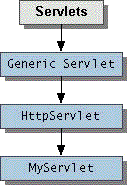
The Servlet interface declares, but does not implement,
methods that manage the servlet and its communications with clients.
Servlet writers provide some or all of these methods when developing a
servlet.
Client Interaction
When a servlet accepts a call from a client, it receives two objects:
- A
ServletRequest, which encapsulates the communication from
the client to the server.
- A
ServletResponse, which encapsulates the communication from
the servlet back to the client.
ServletRequest and ServletResponse are
interfaces defined by the javax.servlet package.
The ServletRequest Interface
The ServletRequest interface allows the servlet access to:
- Information such as the names of the parameters passed in by the
client, the protocol (scheme) being used by the client, and the names of
the remote host that made the request and the server that received
it.
- The input stream,
ServletInputStream. Servlets use the
input stream to get data from clients that use application protocols such
as the HTTP POST and PUT methods.
Interfaces that extend ServletRequest interface allow the
servlet to retrieve more protocol-specific data. For example, the
HttpServletRequestinterface contains methods for accessing
HTTP-specific header information.
The ServletResponse Interface
The ServletResponse interface gives the servlet methods for
replying to the client. It:
- Allows the servlet to set the content length and MIME type of the
reply.
- Provides an output stream,
ServletOutputStream, and a
Writerthrough which the servlet can send the reply data.
Interfaces that extend the ServletResponse interface give
the servlet more protocol-specific capabilities. For example, the
HttpServletResponseinterface contains methods that allow the
servlet to manipulate HTTP-specific header information.
Additional Capabilities of HTTP Servlets
The classes and interfaces described above make up a basic Servlet. HTTP servlets have some additional objects that provide session-tracking capabilities. The servlet writer can use these APIs to maintain state between the servlet and the client that persists across multiple connections during some time period. HTTP servlets also have objects that provide cookies. The servlet writer uses the cookie API to save data with the client and to retrieve this data.
|
|
Start of Tutorial > Start of Trail > Start of Lesson | Lesson Contents |