


 |
Start of Tutorial > Start of Trail > Start of Lesson | Lesson Contents |

|
Trail: Learning the Java Language |
|
Lesson: Object-Oriented Programming Concepts |
|
Help
on searching
Search technology |
What Are Messages?
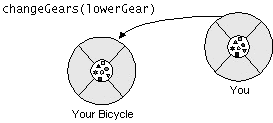
A single object alone is generally not very useful and usually appears as a component of a larger program or application that contains many other objects. Through the interaction of these objects, programmers achieve higher order functionality and more complex behavior. Your bicycle hanging from a hook in the garage is just a bunch of titanium alloy and rubber; by itself the bicycle is incapable of any activity. The bicycle is useful only when when another object (you) interacts with it (starts pedaling).Software objects interact and communicate with each other by sending messages to each other. When object A wants object B to perform one of B's methods, object A sends a message to object B.
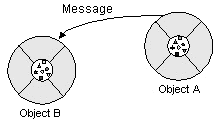
Three components comprise a message:
- The object to whom the message is addressed (Your Bicycle)
-
The name of the method to perform (
changeGears) - Any parameters needed by the method (lower gear)
The Benefits of Messages
- An object's behavior is expressed through its methods, so (aside from direct variable access) message passing supports all possible interactions between objects.
- Objects don't need to be in the same process or even on the same machine to send and receive messages back and forth to each other.
|
|
Start of Tutorial > Start of Trail > Start of Lesson | Lesson Contents |